
Electrical Specifications
Basic Specifications
Section titled “Basic Specifications”All specifications taken at 12V input and 25C ambient temperature unless stated otherwise.
| Abbreviation | Parameter | Test Condition | Min | Typical | Max | Unit |
|---|---|---|---|---|---|---|
| Vin | Input Voltage | No load | 5.3 | 16 | V | |
| Vout | Output Voltage | 0 to 5A load | 5.0 | 5.2 | 5.4 | V |
| Tamb | Ambient Temperature Range | -20 | 45 | °C | ||
| Icont | Continuous Current Output | Continuous | 4 | A | ||
| Itrans | Transient Current Output | For 3 minutes | 5 | A | ||
| Imax | Peak Current Output | For 30 seconds | 8 | A | ||
| Idaisy | Daisy-Chain Current | Continuous | 10 | A |
Other Specifications
Section titled “Other Specifications”| Abbreviation | Parameter | Test Condition | Min | Typical | Max | Unit |
|---|---|---|---|---|---|---|
| Vsurge | Input Surge Voltage | For 5 seconds | 24 | V | ||
| Vdrop | Vin - Vout (Dropout) | No load | 0.3 | V | ||
| Vdrop | Vin - Vout (Dropout) | 4A load | 0.7 | V | ||
| Lr | Load Regulation | 0.01 | V/A | |||
| Pfuse | Input Power Limit | 36 | W | |||
| η | Efficiency | 1A load | 96 | % | ||
| η | Efficiency | 4A load | 92 | % |
Wiring Information
Section titled “Wiring Information”- The input accepts wires between 16-24 AWG. Using wires outside this range may damage the connector or result in poor connections.
- Ferrules can be used on wires between 18-24 AWG for improved connection reliability.
Protection Features
Section titled “Protection Features”The Zinc-V includes built-in protection against short circuits and ESD events on the output.
In case of a short circuit, the Zinc-V will enter a powered-down sleep state until the device is power cycled.
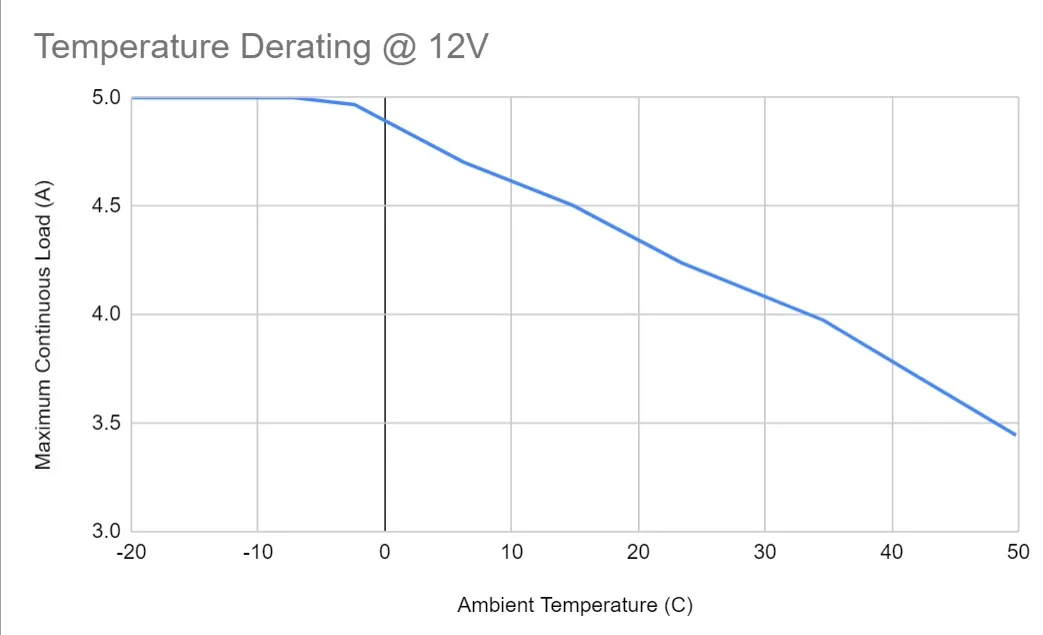
There is a slow-blow resettable fuse on the input, which may have a lower trip current at elevated temperatures. Temporary overcurrent events, as would occur in 12V battery powered systems when the system voltage drops, will not trip the fuse. A chart of allowable continuous load current vs. ambient temperature, in still air, is shown below.